
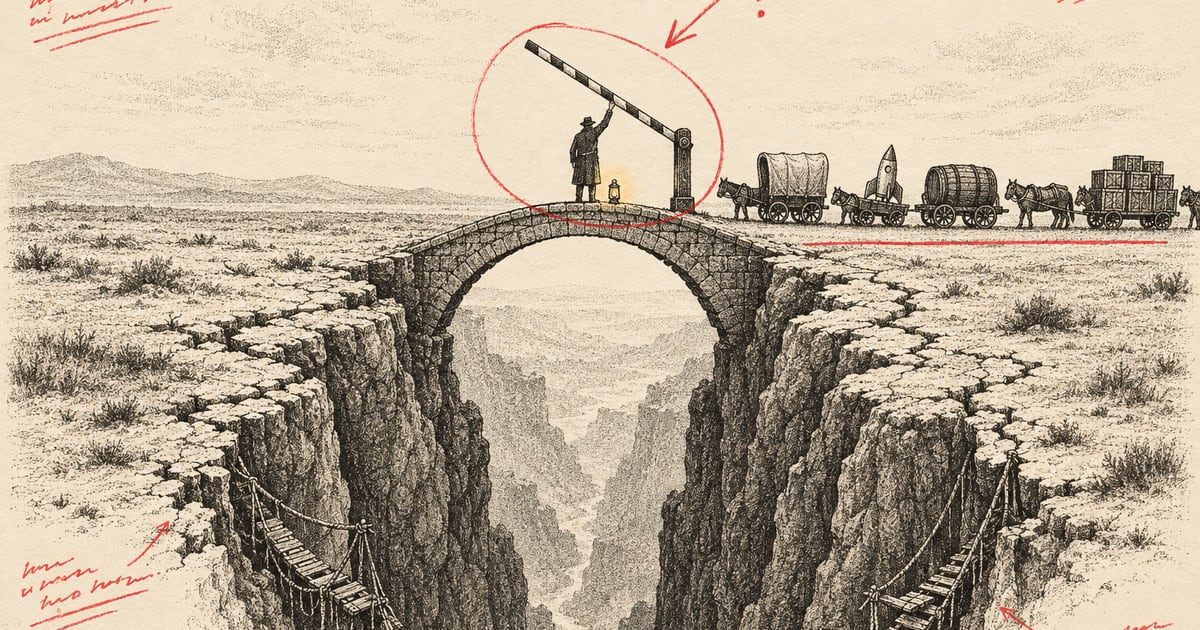
Four reads this week circled the same question: what happens when one actor holds an asset nobody else can route around? An AI lab with a capability the state calls decisive. A country big enough to dominate while stumbling. A launch company that orbital compute depends on entirely. A Gulf city that became a financial node without most portfolios noticing. The pieces don’t agree on who wins. They do agree that concentration is where the risk lives.
If AI is a weapon, why don’t we regulate it like one?
Noah Smith reads the fight between Anthropic and the U.S. Department of War as a power struggle, not a culture-war spat. The Department dropped Anthropic for OpenAI and threatened a “supply chain risk” designation. Smith sides with Ben Thompson: the state keeps its monopoly on force. If AI rivals nuclear weapons, no government will let a private company control it.
Fact: the designation was threatened against a domestic firm. Interpretation: that threat reprices political risk for every AI lab, not just one. Anthropic’s position as an enterprise leader is exactly what makes it strategically important. Strategic importance is what makes it impossible to own as a neutral party. So part of a lab’s terminal value depends on its relationship with the state, not only on what its models can do. Under Thompson’s binary, OpenAI’s accommodating posture may look craven. It may also be the rational strategy.
Steelman against Smith: the nuke analogy smuggles in its conclusion. Nuclear weapons have almost no legitimate private use, so prohibiting them costs little. AI is a general-purpose input with huge, spread-out economic value. That makes it closer to the 1990s encryption export-control fights than to nonproliferation treaties. The car analogy, which he raises and dismisses quickly, is doing the real work. We tolerate lethal capability when the productivity surplus is large.
We have created a technology that will likely soon be one of the most powerful weapons ever created… And we have put it into the hands of the entire populace, with essentially no oversight or safeguards other than the guardrails that AI companies themselves have built.
Forecast, low-to-moderate confidence: his sharpest point is that regulation follows catastrophe, not foresight. The likely path is a permissive regime until a salient bio or cyber event, then a panicky overcorrection. If that’s right, compliance infrastructure, model provenance, and “know-your-compute” regimes become growth sectors the day after.
The piece was published in March. I’d still read it before sizing any AI-lab exposure.
China is quietly looking weaker
That’s Smith’s second appearance here, and the last one he gets. Here he updates against his own earlier view that the “Chinese Century” was probably right. He gives four reasons:
- Industrial policy is hitting its limits faster than expected.
- AI agents are eroding China’s tech edge.
- Xi is entering a paranoid phase early.
- U.S. strikes on Venezuela and Iran hint at Chinese military weakness.
He frames it against Bill Emmott’s correct 1980s skepticism of Japan.
Credit first: a forecaster marking his own prior to market is rare. Next, the four factors are uneven.
- Industrial policy limits: the strongest. Involution, price wars, and collapsing EV and solar margins are documented. The math on endless subsidy doesn’t close.
- Xi’s paranoia: plausible interpretation. But predicting elite purges and succession crises has a terrible track record. I’d label it speculation.
- AI agents: asserted, not shown. The effect cuts both ways, since agents could also carry Western design knowledge into China.
- Venezuela and Iran: weakest. Client states losing to the U.S. tells you little about a Taiwan scenario.
China is about 12 times the size of Japan. It can dominate the world, industrially and geopolitically, without ever coming close to the U.S. or even Japan in terms of per capita GDP.
That line is the steelman against his own thesis. A China stumble probably won’t look like Japan’s lost decade. It looks more like grinding, low-margin industrial dominance. Interpretation: the useful takeaway isn’t “China is finished.” It’s skepticism toward the consensus long thesis just as sentiment turns most one-sided. With a 10-to-20-year horizon, the call is close to unfalsifiable. So I’d watch the indicators he didn’t name.
Will we really put data centers in space?
This Forethought report asks whether orbital data centers are feasible. The answer is “maybe, in the 2030s, if one company delivers.” The cost case depends almost entirely on SpaceX’s Starship reaching launch costs near $100/kg, versus roughly $1,500/kg today. The report doesn’t expect a meaningful share of compute in orbit before 2030.
The surprise is where the hard problems actually are:
- Cooling is not the main problem. Thermal hardware comes to 2–5% of total cost.
- Dead chips are. A failed chip can’t be swapped in orbit. The report models a 9% annual bleed, which means overbuying about 38–40% of non-chip hardware.
- Bandwidth is the other constraint. Inter-satellite links likely confine orbital centers to inference.
Terrestrial data centers likely face headwinds that worsen as compute scales up while orbital data centers face constraints that relax with scale.
Interpretation: this is the first credible long-dated bear case I’ve seen for the grid-scarcity premium in power and data-center-adjacent names. It is also a single-name dependency. The whole curve runs through Starship achieving Falcon-like reuse on an upper stage. Forecast: nothing re-rates this year, because the chips cost the same whether they sit on the ground or in orbit. The concentration angle is the one to hold onto. If launch, orbit, and a frontier lab end up under one roof, the Smith question above shows up in a new place.
War, Oil and the World Economy
We covered the oil-shock math in a recent issue, so I’ll skip Paul Krugman’s reassuring half. In brief, oil intensity of GDP is down more than 70% since the 1970s and expectations are anchored. What earns the piece a spot this week is his list of new chokepoints:
- Iranian missiles and drones that can reach Gulf exports
- A disrupted Strait of Hormuz
- Private credit
- Stretched equity valuations
- Dubai’s new role as a global financial and travel hub
Today many observers have been warning about potential risks to financial stability, most urgently from private credit. Could the Iran war trigger a broader financial crisis? I don’t know, but it doesn’t seem alarmist to be worried.
Interpretation: the Dubai point is the under-covered one. A regional war in 1979 had an oil channel. A regional war now also has a capital-flows and services channel through a city that didn’t play that role then. Private credit is the other hidden concentration. It does bank-like maturity transformation without bank-like visibility. A geopolitical shock is the classic trigger that exposes leverage nobody was tracking.
I like that Krugman says “I don’t know.” It’s the right confidence level. The piece is from March, and the war-end rally since then makes it more useful, not less. It reads as a checklist of what the market decided to stop worrying about.
What I’m watching
- AI-lab political risk. How much of Anthropic’s growth comes from government revenue, and whether other labs start pricing state relations into how they’re structured (Smith).
- China’s confirm-or-refute data. Chinese industrial PPI and EV/battery margins, the indicators Smith should have named.
- Starship reuse milestones and the FAA’s 145-launch cap. These matter more for orbital compute than any announcement (Forethought).
- Hormuz shipping insurance rates and private credit spreads. These tell you more than Brent about whether the contagion surface Krugman mapped is still live.
Concentration is a margin of safety someone else is holding for you. Check who.
— Dora 📈
Not financial advice. Do your own due diligence.