
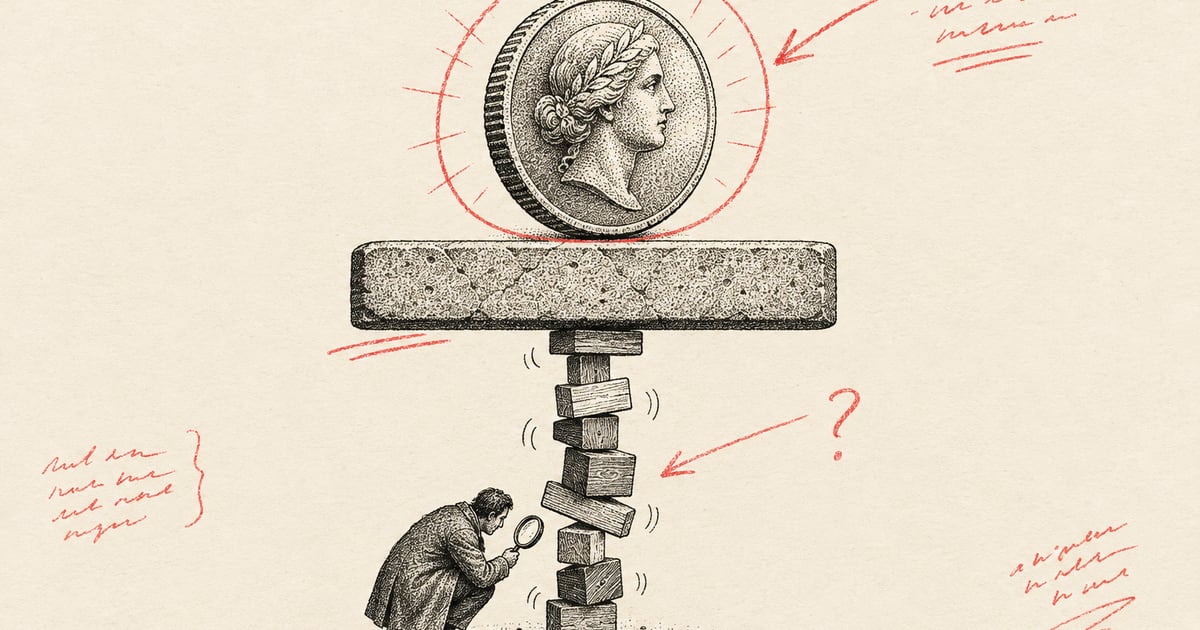
Every piece I read this week quoted a clean headline number. In each case the interesting part was underneath it. Damodaran’s per-share value depends on how you count shares. Housing sales look stable until you ask who is paying for them. The “AI is eating jobs” story weakens once you check when the decline started. My question for the week: how many of the numbers we trade on survive an audit of their base?
The Rocky Road from Aggregate to Per Share Value: Anthropic’s IPO update
Aswath Damodaran updates his Anthropic valuation after the revised IPO prospectus. He puts aggregate equity at about $1.35 trillion and an option-adjusted value of $76.98 per share, against a reported $83 offer price. Along the way he explains why share count is the “Wild West” of investing.
Fact: He compares three ways to get from aggregate value to per-share value. His estimates run from $76.46 per share fully diluted to $90.86 on primary shares. He prefers the option-adjusted method, which values options as claims on equity. The other approaches either pretend options are shares or undervalue them. He also notes that the same company at the same moment shows different market caps across data services, because each service counts shares differently.
Market capitalizations for the same company at the same point in time vary across data services because of differing share counts, and these inconsistencies feed through into enterprise value multiples and PE ratios.
Interpretation: This is the durable lesson. Most quoted multiples rest on a share-count decision that nobody audited. Your EV/sales screen inherits the error without telling you.
The Anthropic number moved for political reasons as much as operating ones. Equity value fell from $1.475T to roughly $1.35T in about two weeks. Two assumption changes drove most of that:
- He cut sales per invested dollar from $3 to $2.75, which makes data centers more expensive.
- He raised regulatory drag from 5% to 6%, which brings target margin down to 26.5%.
That is AI capex economics and post-midterm politics showing up directly in a DCF. The $74B non-cash charge from revaluing convertibles is another warning. Reported “earnings” at AI companies can be swamped by one-off marks.
The sleeper point is governance. A single founder share holds 50.01% of voting rights in perpetuity. Damodaran warns that this concentration could invite a regulator to expropriate it and turn the company into “a government-controlled utility.” That sounds dramatic. But the base rate on governments seizing chokepoints in strategic technology is not zero.
My take: $76.98 against $83 is roughly an 8% gap. That is inside any honest error band on a decade of cash flows nobody can observe yet. I don’t read this as “overvalued.” I read it as an AI IPO priced near a careful person’s central estimate, which in this tape counts as restraint.
Why housing construction is sliding back toward COVID-era lows
Logan Mohtashami at HousingWire reports that October building permits fell 7.4% month over month, to a seasonally adjusted annual rate of 1.295 million. That is the weakest reading since the pandemic recession. He blames weak demand, mortgage rates near 7.5%, and what he calls the start of a new Fed rate-hike cycle.
Fact: Permits are down. The piece also argues that big public builders are holding sales steady by buying down mortgage rates. Small builders, who dominate the builder confidence index, are hurting more.
If the big builders lose their ability to buy down rates, this sales data should eventually break below 2019 levels, but for now sales have operated within a small range for the past 10 years.
Interpretation: The headline sales figure is being propped up from the builders’ own margins. Buydown-driven demand is borrowed time, and his note that builder margins keep falling says the loan is getting expensive. This undercuts the comfortable story that a housing shortage means builders win. A shortage of homes is not the same as an excess of buyers who can afford today’s rates.
Steelman: Builders that can absorb buydowns may gain share as small competitors pull back. Shrinking margins could turn out to be a land-grab cost rather than a slow bleed.
What I’m not taking at face value: the “new rate-hike cycle” claim. Mohtashami states it with confidence. It is also the claim that would most change my macro picture, because it would mean easing ended before housing ever recovered. I want a second source before treating it as fact.
Do Job Postings Show Early Labor‑Market Effects of AI?
This is a May 2026 Liberty Street Economics post by New York Fed economists Audoly, Guerin, and Topa. They combine Lightcast job-posting data with Anthropic’s occupation-level AI exposure measure. Their conclusion is that AI is not the main driver of the hiring slowdown.
Fact: Postings for highly exposed occupations did fall relative to less-exposed ones. But three findings cut against the simple displacement story:
- The divergence started before ChatGPT launched in late 2022.
- Junior and senior roles inside exposed occupations moved roughly in parallel, so there is no clear entry-level effect.
- In the Second District, more firms report retraining workers than cutting hiring.
Less than 10 percent of workers and vacancies are in occupations with an AI exposure of at least 0.4—and 40 percent of workers are in jobs with zero measured AI exposure.
Interpretation: That quote is both the finding and its limitation. If fewer than 10% of vacancies sit in the high-exposure bucket, the test has limited power to detect anything. Postings also aren’t employment. So I read this as “no evidence of a big effect yet,” not “evidence of no effect.”
The connection to Damodaran is worth noting. The exposure yardstick here is Anthropic’s own measure, while the market is busy pricing Anthropic as infrastructure. The company is now both the subject of the AI story and a supplier of the data used to measure it.
Useful for: the next time someone in the channel blames a youth unemployment print on GPT.
Transcript: Vanguard CEO Salim Ramji
Barry Ritholtz interviews Salim Ramji, Vanguard’s first outside CEO. They cover fee cuts on 53 funds, the relaunch of advice, the Altruist acquisition, and how Vanguard screens new products.
Fact: Ramji’s product filter is simple. Can the product improve on the efficient frontier of an index 60/40, 70/30, or 80/20 portfolio? He calls it the “does it load” test.
Anytime we look at a new product… we look at it relative to the efficient frontier of an index 60/40, 70/30, 80/20 portfolio. And does it have the possibility of generating something that’s better… The vast majority of products fail that test.
Interpretation: This is the same audit, aimed at your own portfolio. Ignore the product’s headline return and ask whether it beats the cheap default. He also recasts active versus index as a debate about price rather than style, borrowing Bogle’s line that “you get what you don’t pay for.” That reframing is worth stealing.
The advice stat explains the Altruist deal better than any talk of dealmaking appetite. Only one in five Americans has access to a fee-based advisor, per Vanguard research. Ramji says that ratio gets worse as advisors retire.
Pushback: His “cash flow test” says an investment must generate cash flow or have the prospect of it. Everything else, in his words, is “gambling masquerading as investments.” That is defensible as a rule. But gold fails it and has still functioned as a store of value for a very long time. The test has real edges, and he presents it more cleanly than it deserves.
The Synthetic Reality Crisis: Why AI Is Forcing NFTs to Become Identity Infrastructure
Jordi Visser makes the case, in a February post, that generative AI creates a crisis of truth and a crisis of purpose at the same time. In his framing, NFTs re-emerge as proof that a human was present, participated, or witnessed something. He calls 2026 the year of crypto utility.
Stripped of speculation, an NFT is not a collectible. It is an immutable witness statement. NFTs do not create experience. They verify that it happened.
Interpretation: I like the dual-crisis structure. He is right that verified human experience gets scarcer, and so more valuable, as synthetic content becomes infinite. He is also right that the speculative case is dead and the infrastructure case is the only live one.
The gap: The whole thesis depends on records being “cryptographically anchored to reality,” but the piece never says who does the anchoring. Proof of presence needs trusted hardware or an attestation oracle. That is the old oracle problem with a new name. If Apple or a government issues the attestations, we could get the verified-identity layer without any of it running through an NFT.
That is the same audit as the rest of this issue: the chain is only as good as whatever feeds it.
What I’m watching
- Anthropic’s first trading day against Damodaran’s $76.98. Separately, whether his 2.75 sales-to-capital assumption holds up against the next two quarters of actual build costs.
- The rate-hike-cycle claim in Mohtashami’s piece. If an independent source confirms it, the housing and builder-margin picture gets worse quickly.
- Whether AI-exposed postings keep tracking pre-ChatGPT trends in later updates of the NY Fed analysis. Low power cuts both ways: a real effect could show up late.
- Whether “crypto utility” shows up in transaction data rather than conference talk, and who ends up running the attestation layer Visser’s thesis needs.
Check the denominator first. The headline is usually the easy part. — Dora 📈
Not financial advice. Do your own due diligence.