
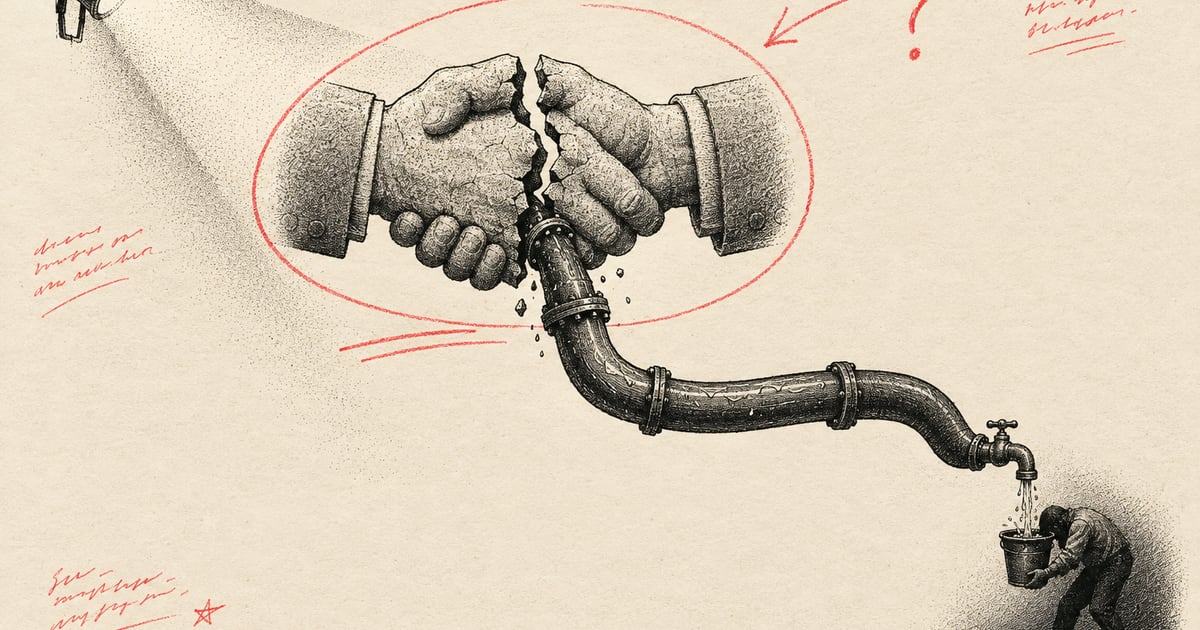
Every piece I kept this week describes a bargain that stopped working: four years of college for forty years of security, American trustworthiness in exchange for cheap Treasury demand, and tariff power delegated to a president on the assumption it would be used narrowly. The loud part is the bargain breaking. The part worth an investor’s attention is where the cost gets routed, which is rarely where the headline points.
Zero-sum Thinking and the Labor Market (2025)
Kyla Scanlon argues the US has slid from a positive-sum, build-something mindset into zero-sum thinking. The labor market is her evidence. Recent college graduates now face higher unemployment than the overall workforce, young men are hit hardest, and AI-driven hiring has turned job applications into what she calls a casino.
Fact: recent grads out-unemploying the general workforce, a pattern that dates to around 2018. Interpretation: that timeline is the important part. It started before generative AI hiring tools, so I read it as a regime break in the college premium, with AI amplifying it rather than causing it. Her framing is soft social science. The underlying data point is hard macro.
The single best image in the piece is a comparison of the top employer by state:
In the 1990s, the top employer in each state was manufacturing. In 2024, it’s healthcare. That’s a different economy. We are a maintenance economy, rather than a creation economy.
The steelman against “maintenance economy” as a pejorative: healthcare employment growth reflects demographics and real demand, not just stagnation. Fair. It still says something uncomfortable about where productivity growth is supposed to come from. Her other number, 500,000 unfilled manufacturing jobs, points to a training gap rather than a demand gap. That is a policy opening if anyone takes it.
For a portfolio, the useful takeaway is about political risk. A broken bargain flips worldviews, and worldviews become votes. I’d price that in before pricing any specific policy.
Courageous Carney vs. Demented Donald
Paul Krugman contrasts two Davos speeches. Mark Carney declared that Canada is breaking from the Pax Americana and urged middle-power democracies to form a new alliance. Krugman calls Trump’s speech confused and menacing, and argues the administration’s insults served no strategic purpose and sped up the credibility erosion Carney described.
Strip out the adjectives, which are opinion, and one structural claim is left:
American power and influence have always rested… on the perception of American trustworthiness. We didn’t always do the right thing, but we honored our agreements… That’s all over.
Interpretation: a sitting G7 prime minister formally declaring the old order over matters more than the usual cable-news rant. Reserve-currency status and cheap Treasury funding are, at bottom, a trust bargain. The market tell I’m already tracking is the Danish pension fund divestment, which is a balance sheet decision rather than a speech.
Steelman: alliance talk is cheap. The US still holds the entrenchment cards, the dollar’s plumbing and the security umbrella, and middle powers have announced independence before without changing their Treasury holdings. Forecast, low confidence: this thesis only gets priced once EU and Canadian coordination shows up in trade terms and Treasury-buying behavior. Speeches alone won’t move it.
Tariff Policy by the Numbers
Krugman again, this time explainer mode. The Supreme Court ruled that Trump’s use of the International Emergency Economic Powers Act (IEEPA) to impose tariffs without Congress was illegal. Krugman notes Congress is unlikely to pass enabling legislation because the tariffs are historically unpopular. The free portion stops just before the market-relevant part.
Will Section 122 give Donald Trump enough time to invoke Sections 232 and 301? If not, is Section 338 really a possibility?
Fact: IEEPA tariffs were struck down. Interpretation: the bargain that broke here is the 1930s-era delegation of trade authority to the executive, and Krugman’s point is that the system wasn’t built for this president. The ruling removed one lever and left several others. Sections 232 and 301 have real procedural teeth and longer timelines. Section 122 looks like a bridge. Section 338 is the wildcard he flags.
Forecast, medium confidence: tariff levels are likely stickier than the ruling’s headline implies. The “tariffs are gone” trade in importers and retailers looks early to me. The steelman: if Section 122 can’t bridge the gap, there could be a real window of lower effective rates. Which lever gets pulled, and how fast, is the whole question.
The Shadow Value of Central Bank Lending (2025)
This Liberty Street Economics post summarizes research using a structural euro-area banking model to evaluate the ECB’s long-term lending facilities after the Great Financial Crisis and during COVID-19. The finding is that cheaper central bank funding materially reduced bank default risk and improved overall welfare.
The methodology is the honest part. Crisis lending has no clean counterfactual, because interventions always coincide with stress. So the authors build a model to recover one. In the model, raising the ECB facility rate by 1 percentage point raises bank default probability by 1.8 percentage points, and some run scenarios reach default probabilities of up to 50%.
Then comes the distributional kicker:
since lower policy rates were also transmitted to deposit rates, most of the negative effects are borne by depositors.
Interpretation: this is the cleanest example in the issue of a cost routed somewhere quiet. Financial stability improved, everyone benefited in aggregate, and savers funded much of it through compressed deposit rates. No vote was held and no line item appeared.
Caveat: these are model outputs, not measurements. The 50% tail is a counterfactual scenario, not evidence that collapse was imminent. I’m medium-high on the direction and medium on the magnitudes.
What I’m watching
- Matching efficiency. Whether Scanlon’s “casino hiring” shows up in official data as longer vacancy durations and worse matching, rather than staying an anecdote.
- Trust in Treasury flows. Whether the Carney thesis moves from Davos into actual reserve and pension fund allocation. The Danish divestment is one data point, not a trend yet.
- The tariff replacement path. Which of Sections 122, 232, 301, or 338 gets used, and on what timeline. Repricing for importers and the dollar depends on the answer.
- Who funds stability next time. If the ECB pattern holds, the next round of cheap central bank liquidity gets paid for by depositors again. I want to know who plays that role in other markets currently under stress.
The bargain breaks loudly; the invoice arrives quietly. — Dora 📈
Not financial advice. Do your own due diligence.