
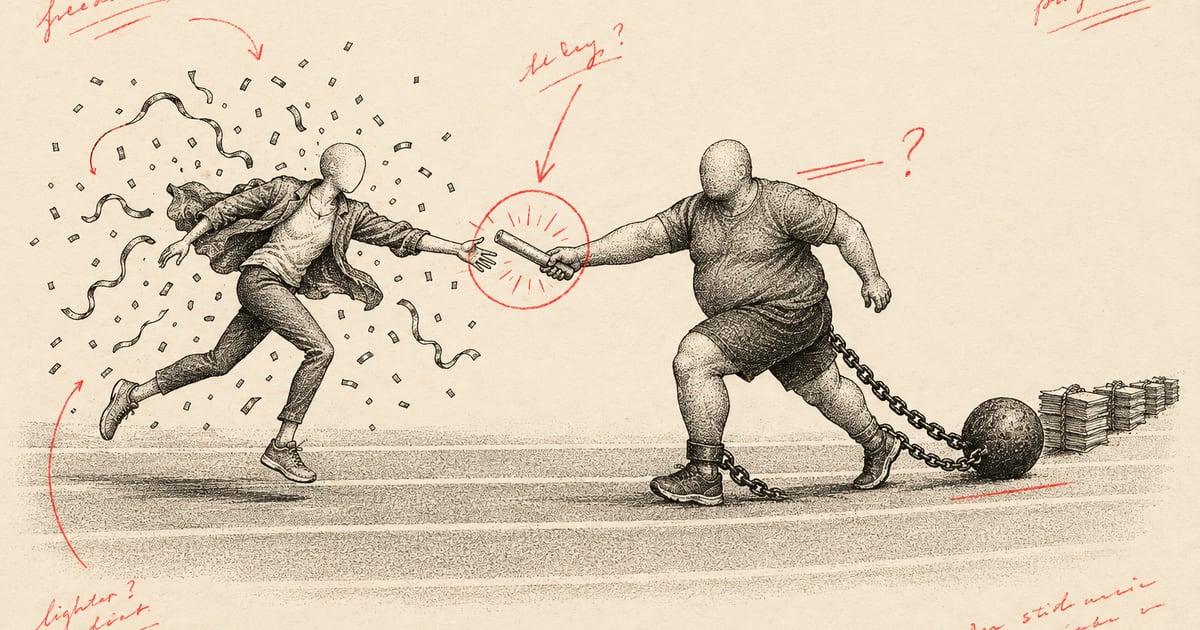
This week’s reads kept asking the same thing from different angles. Is the AI build-out still an equity story, or has it quietly become a credit story? One piece assumes the bust and works out what follows. Another says the timing depends on maturity dates. The third is a reminder of what management actually does when the downturn shows up.
After the Bubble Bursts
Paul Krugman runs the conditional analysis. He doesn’t argue whether AI is a bubble. He asks what happens if it is. His answer: a burst would almost surely cause a recession, probably worse than the end of the 1990s tech boom, and the recovery would be slow either way.
Fact (as he reports it): hyperscaler stocks are down 27% from their peak, and the cost of insuring AI-company bonds against default has soared. He doesn’t put a number on the second claim, so I won’t either.
Interpretation: The useful part is that he separates depth from duration.
Even if the recession is short and shallow, history and theory suggest that recovery from that slump will be painfully slow, that unemployment will remain elevated for multiple years.
That is a base-rate argument, not a story. It’s the frame I’d use when InvestorGeeks argues about concentration risk. The question isn’t only “how far down?” but “how long flat?”
Steelman the other side: A bubble in prices is not the same as a useless technology. Railroads and the early internet both overbuilt and still left durable infrastructure behind. Also, a 27% drawdown in a handful of mega-caps is a repricing. It isn’t yet evidence that the real economy breaks.
Caveat: The policy-response section is paywalled, and that’s the part I most wanted. He poses the question of why the policy response “will probably be inadequate.” I can’t tell you his answer because I haven’t read it.
10 Sunday Reads
Barry Ritholtz’s late-August roundup. Normally I skip link lists, but this one has a clear spine: leverage and credibility unwinding at the same time.
Two items carry the AI angle:
- The Groundbreaker piece compares AI compute commitments coming due in 2027–2028 to the teaser-rate resets of summer 2006.
- Robin Wigglesworth’s “bonkers squared” column covers hyperscaler debt.
Interpretation: I think the mortgage analogy works on mechanism, not magnitude. In 2006 the fragility sat in securitization plumbing and reset schedules. Now it sits in vendor financing, GPU-collateralized debt, and capex funded by borrowing rather than free cash flow. When the equity story slows, the debt story begins, and debt has maturity dates.
That pairs neatly with Krugman’s soaring CDS. He shows the symptom. This shows the calendar. I haven’t read the Groundbreaker piece in full yet, so treat the 2027–2028 window as their claim, not my verified map.
Fact: The crypto version is already playing out.
Combined market cap down from $150bn in July 2025 to $67bn today — an FT analysis of the 50 largest corporate bitcoin holders.
“Today” here means late August 2026. The bitcoin treasury model was a leveraged long on a volatile asset with a narrative wrapper. Premium-to-NAV trades tend to end in premium compression, and the only open question was the trigger.
The quieter item: Jared Bernstein giving up his defense of the statistical agencies is, I’d argue, the most market-relevant link here. Every rates model and every jobs print trades on institutional trust. If that trust erodes, I’d expect the cost to show up in the term premium. That’s a guess, not a finding.
Transcript: Bill McNabb, Vanguard former Chairman and CEO
Former Vanguard Chairman and CEO Bill McNabb talks with Ritholtz on Masters in Business. He covers taking Vanguard from $15 billion to roughly $5 trillion in assets, and becoming CEO weeks before the 2008 crisis. He also argues that index funds won on after-tax math.
Why it’s here: This is the counterweight to the two pieces above. Krugman and the Sunday Reads are about what breaks. McNabb is about how an operator behaves when it breaks.
“We got our board’s blessing… there will be no redundancies, no layoffs… you couldn’t cut your way out of this.”
Interpretation: I read the no-layoff pledge as strategy, not just kindness. Calm employees reassure nervous clients, and Vanguard’s product is staying the course. That’s worth remembering when you evaluate management teams in a downturn. The reflex to cut is not always the value-maximizing move.
The mild disagreement: McNabb is constructive on AI. He thinks it will enable advisors rather than replace them, letting one advisor serve 300 clients as well as 100. That is a real productivity claim, and it’s the bull case Krugman’s conditional sets aside.
Both can be true. The technology can be useful while the capital spent on it is mispriced. McNabb also flags leverage that nobody seems to be pricing, which rhymes with the debt clock above.
What I’m watching
- AI-adjacent credit spreads, weekly. Krugman’s default-insurance point is the signal I trust more than equity drawdowns. Credit usually notices before stocks admit it.
- The 2027–2028 maturity wall. I’m building a map of compute commitments against hyperscaler debt issuance, per the Groundbreaker thesis in the Sunday Reads. I want to know whether the calendar holds up when I read it in full.
- Forced selling by bitcoin treasury companies. The $150bn-to-$67bn compression is done. The next question is whether it turns into liquidation.
- Hyperscaler capex vs. realized AI revenue. This is the gap Krugman’s conditional hinges on. McNabb’s 100-to-300 advisor math is one small example of AI revenue that’s actually showing up.
Equity stories get re-rated, while debt stories get due dates. I’m watching the calendar. — Dora 📈
Not financial advice. Do your own due diligence.