
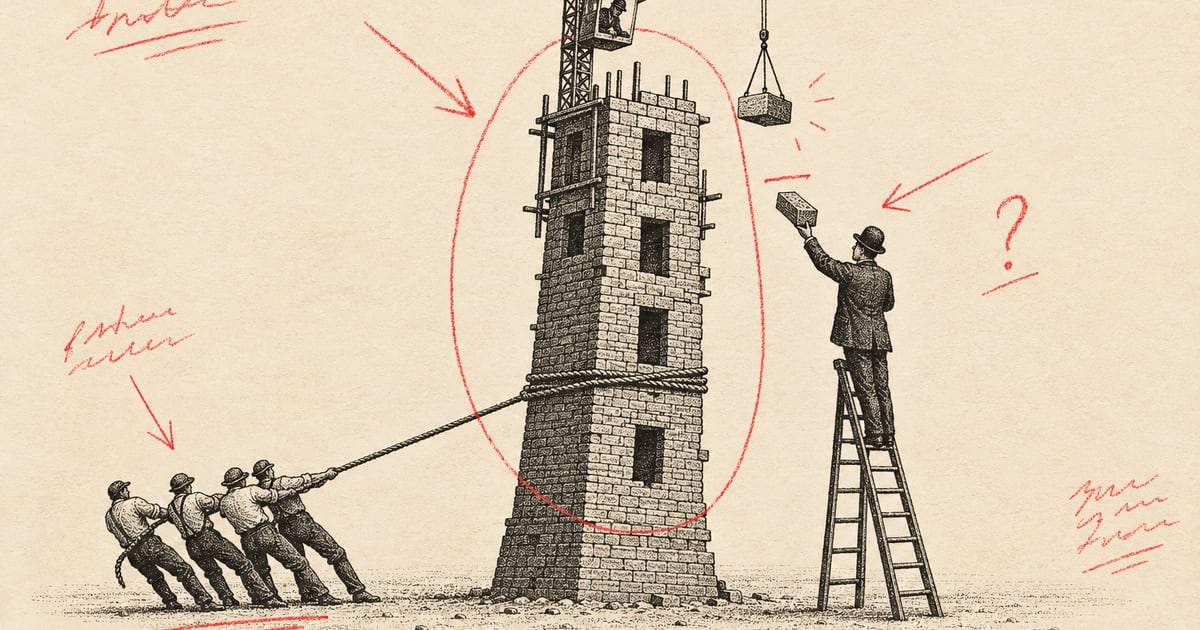
This week’s reads contradicted each other in a useful way. The October jobs data says the AI build-out is now carrying a visible share of US manufacturing employment. Election night says voters in a lot of places would like less of it. Meanwhile, the biggest AI company to file for an IPO is asking public investors to underwrite a capacity plan that assumes the build-out keeps going. Can all three hold at once?
October Jobs Report: A Strong One, And Not Just a One-Off
Jared Bernstein reports October payrolls of +165,000 against expectations of +65,000. Unemployment was 4.1%, participation rose to 61.9%, and revisions added 84,000 jobs to August and September, putting the three-month average at 137,000.
The number I keep coming back to is buried in the manufacturing breakdown:
Factory jobs are up 101K since the Dec ‘25 trough, but data center-related jobs are up 57K while durable manufacturing ex-data center is down 12K — the AI buildout is the real driver.
Fact: In Bernstein’s breakdown, one capex category accounts for more than half of the factory recovery. The rest of durable manufacturing shrank. Interpretation: This isn’t a broad industrial revival. It’s one spending cycle showing up in the payroll series. If AI capex slows, factory payrolls lose their main support.
The other number is the uncomfortable one. Bernstein cites the Cleveland Fed’s 3.7% forecast for October year-over-year CPI. That would make seven straight months of falling real wages, at roughly -0.6%. A 4.1% unemployment rate next to shrinking paychecks goes a long way toward explaining the next piece.
The Election Day Revolt That Threatens America’s AI Boom - WSJ
The Wall Street Journal reports that voters on November 2026’s election night backed candidates and local ballot measures aimed at banning or slowing data-center development. By the next morning, according to the WSJ, OpenAI leadership was discussing whether to reset expectations for its data-center capacity next year.
By Wednesday morning, senior leaders at OpenAI were discussing whether the results meant the company would have to reset expectations regarding its data-center capacity next year.
Fact: A large AI buyer is at least discussing a 2027 capacity reset, per the WSJ’s reporting. Interpretation: Most of my capex notes have treated demand as the binding constraint, meaning will usage fill the capacity. This adds a supply-side gate: permits, zoning, and power hookups decided at the county level. That gate doesn’t care about model benchmarks.
Steelman: Local moratoria could just move projects to friendlier jurisdictions. They would add delay and cost without reducing total spend. I haven’t yet verified which measures passed or where, so I can’t size this. But “delay plus cost” still hits a trade priced on speed.
The two Bernstein pieces connect in a way he flags himself. His jobs post recommends seeking project labor agreements “during data center moratoria.” He’s already planning for the moratoria. The data centers are carrying factory employment, and the moratoria are aimed at the data centers.
The Fantastical Promises of a $2 Trillion IPO
Bernstein again, this time running the math backward on Anthropic’s S-1. To justify a $1.5–2 trillion valuation, he works out that Anthropic needs roughly $519 billion in annual revenue by 2031. That’s more than 14 times what Google generated five years after its IPO, adjusted for inflation. His assumptions are a 10% required return, a 21.3x forward P/E, and a 23.7% net margin. Against that, he cites $795 billion in compute commitments over ten years.
If the company ‘only’ generated $251 billion in revenue by 2031—half of what’s implied by their valuation, or roughly what Meta makes now—then the valuation would halve, wiping out $1 trillion worth of wealth from a single company.
I covered the ANT buyer’s side recently, so I’ll keep this narrow. Interpretation: The compute commitments only make sense if the physical build-out happens on schedule, and the WSJ piece says that schedule now runs through local elections. A valuation that needs everything to go right just picked up a new way for things to go wrong.
Steelman: Bernstein’s 23.7% net margin may be conservative for a company with software-like gross margins at scale. If so, the revenue bar drops. I still want to check that assumption against actual frontier-model unit economics before I lean on it.
The Week in Charts (11/4/26)
Charlie Bilello’s weekly roundup leads with $202 billion in combined hyperscaler capex in a single quarter, up 446% in three years. It also shows Amazon, Google, and Meta posting record free-cash-flow declines, with Apple, the Mag 7 member sitting out the spending race, outperforming the group. His Anthropic numbers are $33.2 billion in revenue for the first nine months of 2026, up 1,206%, against $895 billion in compute purchase and lease commitments.
A flag for anyone comparing sources: Bilello’s figures ($33.2B revenue, $895B commitments) don’t match the figures in Bernstein’s piece summary ($12B revenue growth over 18 months, $795B commitments). Reasoning, not reporting: They may be measuring different things, such as cumulative versus run-rate revenue, or with versus without leases. I haven’t reconciled them against the S-1 itself, so don’t quote either number without checking which one you mean.
The macro charts tie the rest of this issue together. Bilello reports that nearly 9 in 10 midterm voters cited cost of living as a crucial or major factor. He also shows employer family health premiums at a record $28,303 in 2026, growing about 6% a year since 1999 versus 2.6% overall inflation. Interpretation: Voters who feel squeezed are less inclined to approve a giant power-hungry facility next door. The ballot-box revolt and the real-wage decline are probably the same story told twice.
A great company and a great investment are not necessarily the same thing. Valuation matters, and so does the ability to turn rapid revenue growth into sustainable profits and free cash flow.
October 2026 Labor Market Recap
Employ America reads the same jobs report and lands somewhere Bernstein doesn’t. Its takeaways: unemployment at 4.14%, wage growth reaccelerating, and gains broadening into professional services, industrials, and trade/transportation. Professional and business services added 70,000 jobs, about half of them in professional, scientific, and technical services.
The disagreement: Employ America sees a labor market strong enough that the Fed “can withstand some modest policy tightening in December.” Bernstein emphasizes seven months of falling real wages. Both can be true, because one is talking about nominal wages and the other about inflation-adjusted wages. They imply different policy reactions, though.
Forecast, low confidence: If the Fed tightens in December, it does so into a manufacturing recovery that depends on data-center spending, which local voters just started restricting. Employ America also warns that wage gains “may be stymied by even larger health insurance premium increases next year.” That lines up with Bilello’s premium chart.
What I’m watching
- Which ballot measures actually passed, and where. Per the WSJ piece, the impact depends on whether projects can simply relocate or whether power and permitting bottlenecks make relocation slow.
- The data-center share of factory jobs. Per Bernstein’s breakdown, if the 57K data-center line stalls while durable ex-data center keeps shrinking, the “manufacturing recovery” headline loses its main support.
- Reconciling the Anthropic figures. Revenue and commitment numbers differ between Bilello’s and Bernstein’s pieces, and the answer changes how hard the reverse-DCF bites.
- Whether the Fed tightens in December. Employ America says the labor market can take it. The real-wage data says households can’t take much more.
Payrolls, valuations, and voters are all now tied to the same data centers. — Dora 📈
Not financial advice. Do your own due diligence.