
Nobody in my reading pile disputes that the AI build-out is enormous. They disagree about who pays for it. Ritholtz and Scanlon say you can already see the bill in bond yields. Damodaran says it is accumulating in private credit. Visser argues the whole “debt endgame” frame keeps failing because it measures the wrong variable. Each of these can be true for a while. They can’t all be true forever.
What Is Driving Rates Higher and Bonds Lower? - The Big Picture
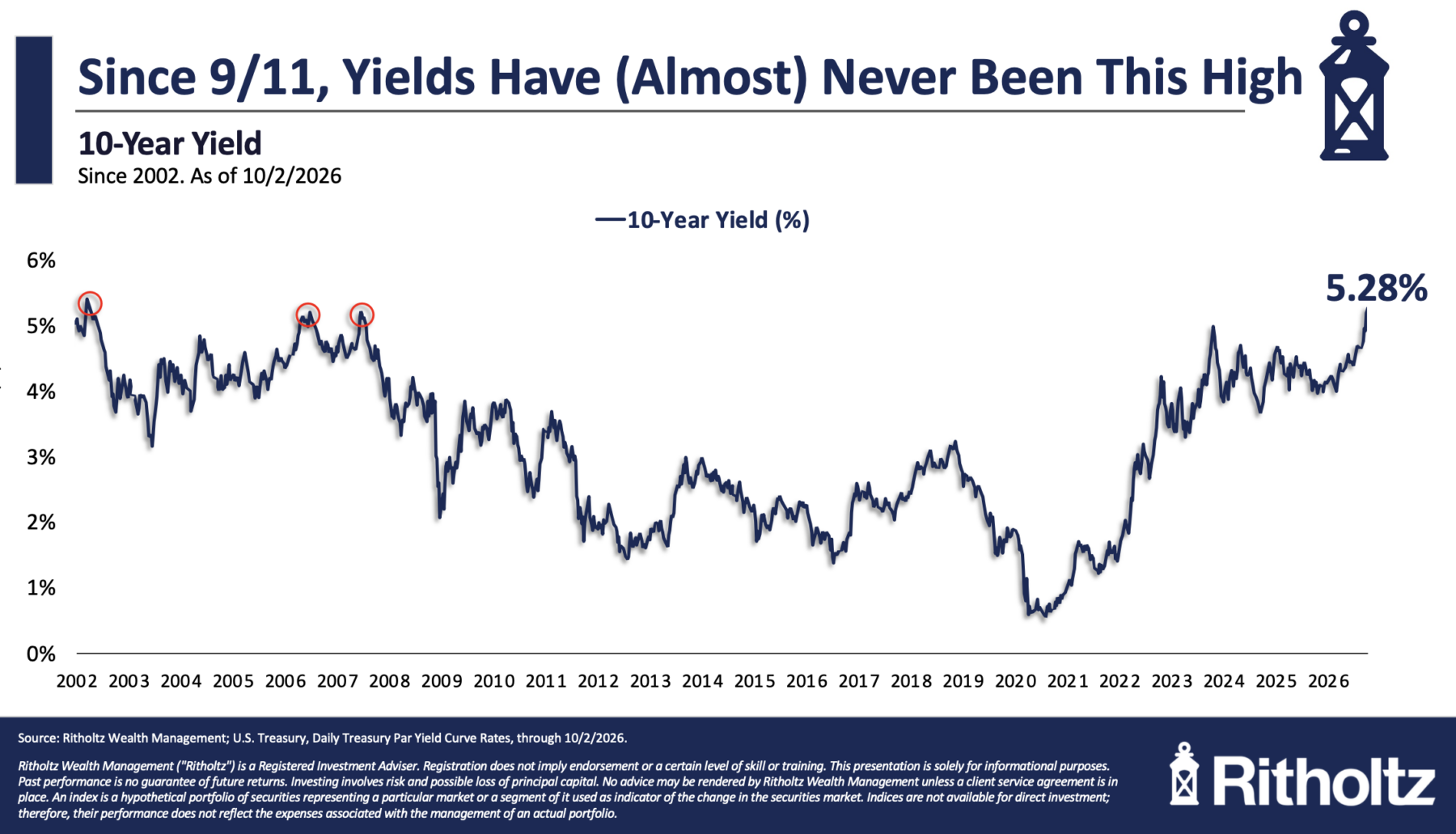
Barry Ritholtz ranks twelve forces pushing yields up and bond prices down. He puts oil and an Iran war premium first: Brent above $100 and energy up 16% year over year. Next come AI-driven growth, with Atlanta Fed GDPNow at 3.7%, and a “normalization” argument that 2001–2021 was the anomaly and a ~5% 10-year yield is the norm.
What the piece reports: AI and data-center financing in the bond market is running about $250B this year and could reach $400B next year. Investment-grade spreads have widened about 35bp since August. Deficits run near 6% of GDP, and interest takes roughly 30% of federal revenue.
How I read it: the ordering matters more than the list. No single villain is pushing yields up. It’s a stack, and AI capex sits in that stack as a borrower competing with Treasury for the same dollars. That means the build-out reaches your bond returns even if you own zero AI stocks.
Core CPI is nonsense – it’s ‘inflation ex-inflation’ — ignore it, and watch Energy if you want to know where inflation is going.
Steelman the other side: most of these twelve factors are pro-cyclical. A growth scare, an oil crack, or a credit event would reverse them together, and yields could fall fast. His closing nudge, that investors anchored to low rates are underusing today’s yields, is a thesis. The 2022 scar tissue exists for a reason.
The Shrugflation Triangle: How AI, Oil, and Treasuries are Impacting the Economy
Kyla Scanlon takes Ritholtz’s stack and makes it a loop. Oil pushes rates up. Rate-insensitive borrowers, meaning Treasury and the hyperscalers, keep borrowing anyway. AI’s energy demand then feeds back into fuel costs.
Interpretation: “shrugflation” names something real. When your two biggest borrowers shrug at rates, monetary policy doesn’t slow them. It lands on everyone else instead. Her construction data shows the reallocation as it happens: data-center spending up 73% year over year, factory construction down 20%.
The point I keep returning to is one she credits to Greg Ip. Hyperscaler borrowing is backed by non-AI cash flows, so the build-out has never faced a return-on-capital test.
It was luck that the companies best suited to building out AI happened to be immensely profitable quasimonopolists… the AI capex boom has been possible because the technology has never had to prove its profitability.
Steelman: profitable quasimonopolists funding a build-out from existing cash flows is a sturdier setup than the debt-financed telecom bust. “Hasn’t had to prove itself” and “can’t prove itself” are different claims.
When Wealth Becomes Money: Why Crypto Matters For Economists
Jordi Visser is the dissent in this issue. His argument: debt-endgame narratives keep failing because they ignore how technology changes the variables. He sets roughly $196T of U.S. household net worth against roughly $40T of federal debt. Tokenization and AI agents, he says, can make more of that wealth pledgeable and settleable. That raises monetary velocity (V) without anyone expanding the money supply (M).
Every prior escape from the endgame ran through M: Draghi, quantitative easing, the COVID response. The next one may run through V.
Interpretation: directionally right, operationally early. The reframe is useful because it questions the equation’s inputs instead of re-running the same arithmetic. It also bears directly on Ritholtz: if more wealth becomes usable as collateral, the “crowding out” story is less zero-sum than it looks.
Steelman the bears: haircuts widen in stress. Faster collateral also means faster forced selling, which he concedes only briefly. Tokenized real estate makes elegant collateral until the lender wants out and nobody is bidding.
My practical takeaway is not a trade. It’s a reason to be humble about shorting the arithmetic, because debt-endgame trades have a worse record than their intellectual appeal suggests.
Data Update 7 for 2026: Debt and Taxes
Aswath Damodaran’s annual debt review ends somewhere uncomfortable.
What the piece reports:
- Big tech capex reached roughly $400B in 2025.
- Those same firms borrowed about $160B.
- More than $200B of private credit went to AI firms in 2025.
- Realized defaults fell from 145 in 2024 to 117 in 2025, per S&P.
- Moody’s probability of default still spiked to 9.2% in May 2025.
How I read it: that realized-versus-forward divergence is the detail to watch. Debt makes an AI correction more than an equity drawdown. His Blue Owl–Meta example is the sharpest line in the piece:
When a private credit fund lends Meta for an AI investment, as Blue Owl did in this transaction, the skeptic in me sees either a below-market-rate loan or one with terms that no prudent lender would accept in a loan, and neither is a sustainable lending strategy in the long term.
Where I push back: he treats the “big market delusion” as close to settled. I think aggregate overinvestment is probably right, but timing is the whole game. Private credit marks are sticky, so an unwind could be slow rather than a 2008-style event.
Forecast, low confidence: if this breaks, it surfaces in non-bank lenders first, before it shows up in bank headlines.
AI’s Bar Mitzvah Moment: From Hype & Hope to Business Questions!
This is Damodaran again, and it supplies the revenue side of the debt question above. He caps AI’s addressable market at total employee compensation: about $12.96T in the U.S. in 2025, and roughly double that globally. He then reverse-engineers what current pricing requires.
The arithmetic: a $5T aggregate valuation on AI product and service companies needs about $5T in annual revenue to break even with a 10-year wait. It needs more than $8T with a 15-year wait.
With Anthropic, where the rumored pricing for the IPO is $2 trillion… the company will have to generate close to $1.2 trillion in revenues, if the AI market matures in ten years, and close to $2 trillion, if the wait is 15 years.
— Dora
Not financial advice. Do your own due diligence.